Powered by: Xversion Corporation

Astronomy

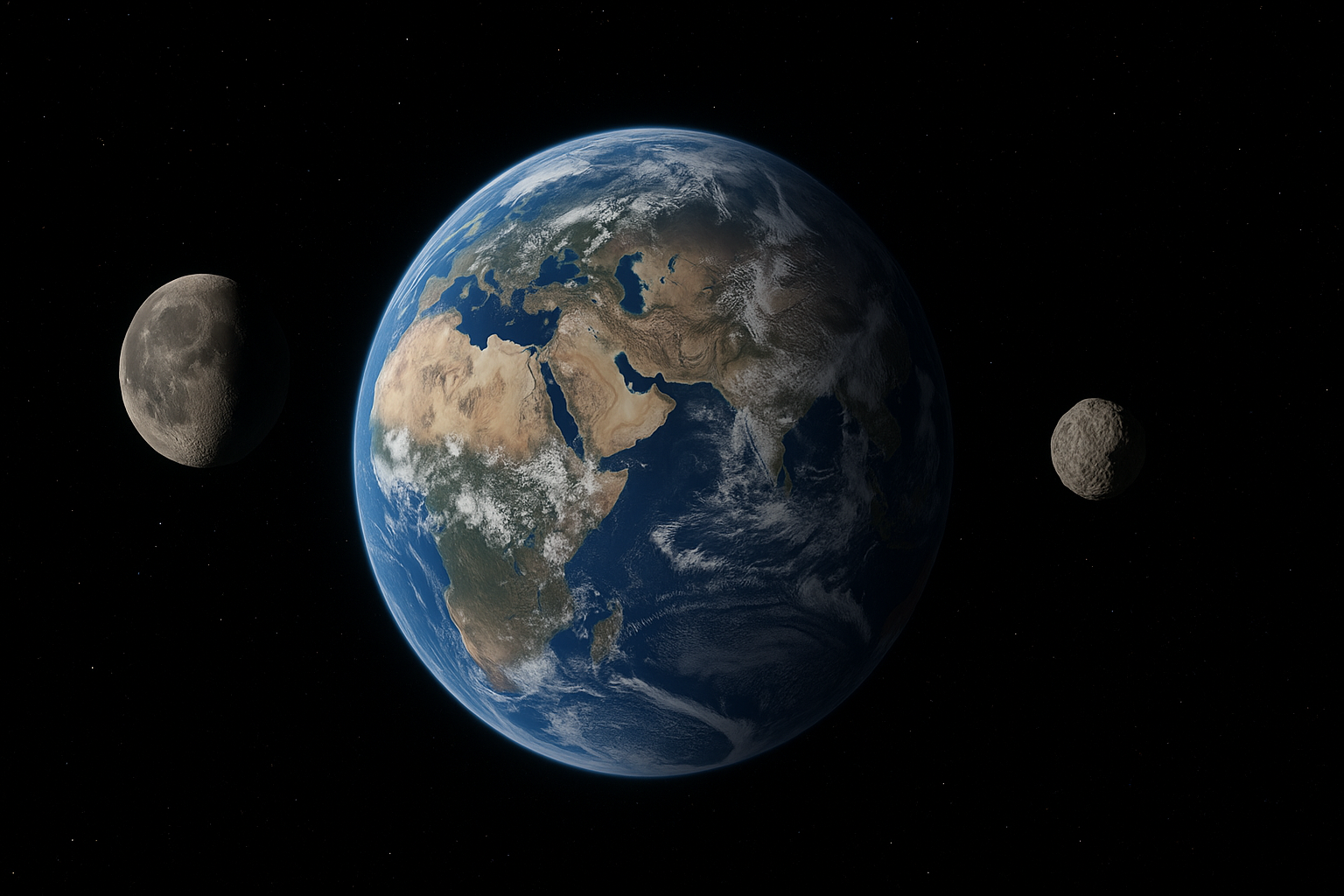
Quasi-Moon: Hidden Moon of Earth captured.

Beyond Earth’s single natural moon, hidden companions called quasi-moons orbit the Sun in near lockstep with our planet — appearing to dance around us for centuries.

starzz

starzz

we provide space information

Oct 30, 2025
6 min read
130 views
Quasi-Moon: Hidden Moon of Earth captured.

Earth's Quasis moon

What Are Quasi-Moons?

A quasi-moon, also called a quasi-satellite, is a small celestial body that appears to orbit Earth but actually circles the Sun. These fascinating objects travel around the Sun in a path nearly identical to Earth's, creating the illusion that they are secondary moons. They remain near our planet for centuries, tracing complex loops in the sky.

Unlike our true Moon, quasi-moons are not gravitationally bound to Earth. Instead, they are in a 1:1 orbital resonance — meaning they complete one orbit around the Sun in roughly the same time as Earth. This unique relationship allows them to stay close, yet never be captured.

quasis moon
quasis moon

How Quasi-Moons Orbit

From Earth’s perspective, a quasi-moon seems to loop around our planet in a slow, graceful motion. However, in reality, it’s orbiting the Sun — not Earth. Its motion results from a delicate gravitational balance between the Sun and our planet, placing it in what’s known as a co-orbital configuration.

These objects can shift between different orbital states over time, such as becoming a horseshoe orbit companion before returning to a quasi-satellite state. Gravitational influences from other planets, particularly Jupiter and Venus, constantly nudge their orbits.

Types of Co-Orbital Objects

  • Trojans – Objects orbiting near a planet’s Lagrange points (L4 or L5).
  • Horseshoe Orbiters – Follow a horseshoe-shaped path relative to a planet.
  • Quasi-Satellites – Appear to orbit a planet while actually orbiting the Sun.

Known Quasi-Moons of Earth

Over the past few decades, astronomers have identified several quasi-moons that share Earth’s orbit. Each one has unique orbital characteristics and lifetimes, ranging from a few centuries to millennia.

  1. (469219) Kamoʻoalewa – Discovered in 2016 by Pan-STARRS. Possibly a fragment of the Moon. It remains Earth’s closest quasi-satellite, expected to stay near us for hundreds of years.
  2. (164207) 2004 GU9 – Found in 2004, this object approaches Earth within 15 million km and has a stable orbit for centuries.
  3. (277810) 2006 FV35 – Alternates between quasi-satellite and horseshoe orbits.
  4. 2013 LX28 – A temporary quasi-moon with a highly tilted orbit.
  5. 2023 FW13 – The latest discovery, predicted to stay near Earth until about the year 3700.

Discovery and Observation

Although the concept of co-orbital companions was proposed decades ago, the first quasi-moons were confirmed only in the 2000s. Modern sky surveys like Pan-STARRS, Catalina Sky Survey, and the LSST (Vera Rubin Observatory) have made detection possible through precise astrometry and motion tracking.

These bodies are small — often between 40 to 100 meters across — making them difficult to spot. Their orbits are also unstable over long timescales, slowly evolving due to gravitational interactions with other planets and the Moon.

Scientific Significance

  • Orbital Mechanics – Studying quasi-moons helps astronomers understand gravitational resonance and orbital stability.
  • Planetary Formation – Their composition and trajectories may reveal insights into early Solar System debris exchange.
  • Future Exploration – Low-energy trajectories make them ideal targets for robotic or crewed missions.

Quasi-moons are like natural laboratories that teach us how celestial bodies share orbital paths. Understanding their interactions can help refine models for asteroid migration and capture.

Physical Characteristics

Most quasi-moons are irregularly shaped and composed of rocky material. Some may be dark, carbon-rich asteroids, while others might be pieces of the Moon ejected long ago by massive impacts.

For instance, observations of Kamoʻoalewa show that its spectral signature closely matches lunar regolith samples. This hints that it could be a chunk of our Moon that escaped into a stable orbit around the Sun alongside Earth.

Future Missions to Quasi-Moons

China’s upcoming Tianwen-2 mission, launching around 2025, plans to visit Kamoʻoalewa — marking the first quasi-moon sample return mission. The spacecraft will collect surface samples and return them to Earth, providing critical insights into its origin.

If Kamoʻoalewa is indeed a lunar fragment, it could solve long-standing mysteries about how material escapes Earth-Moon gravity and travels through space while maintaining near-Earth resonance.

The Future of Earth’s Quasi-Moons

Quasi-moons are temporary companions. Their delicate orbits last for centuries or millennia before drifting away. Simulations suggest that Earth may always host at least one small quasi-moon at any time — though each comes and goes with cosmic rhythm.

The study of quasi-moons bridges the gap between asteroids and natural satellites, revealing the complexity of orbital dynamics in our Solar System. As technology advances, we’re likely to find more of these subtle companions quietly accompanying our planet through the cosmic sea.

#earth#quasi-moon#astronomy#space#orbit#kamo'oalewa
130
Views
0
Likes
0
Comments

Discussion (0)

Join the conversation

"Comment functionality coming soon."

earth quasis moon | StarzzSpace